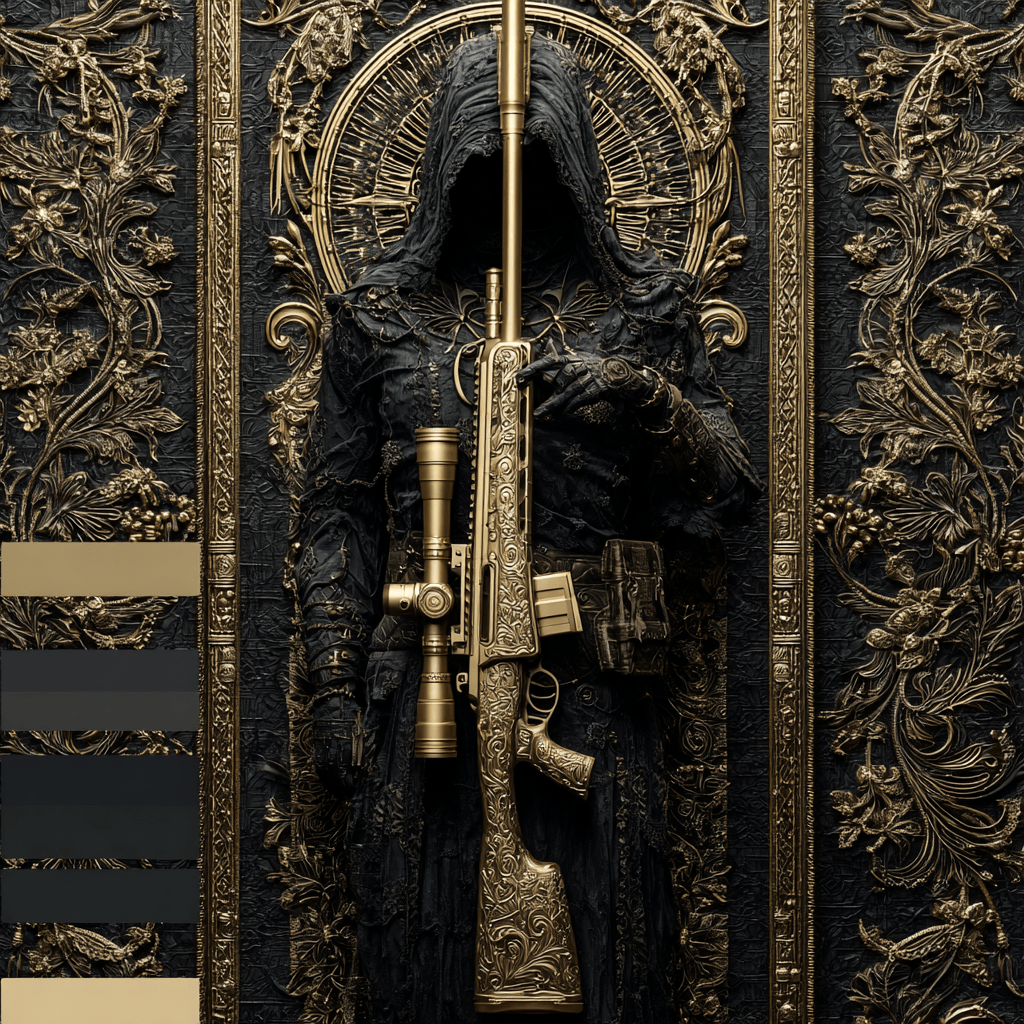
Is there a mantra for snipers? Maybe it should be: never take what isn’t worth taking.
The production of another hitman movie–even a really good inventive one like BULLETFLASH–is not necessarily a topic we cover in these pages typically.
But in the case of this one, a particular fascination arises over a small but utterly unsolveable detail that occurred during the filmmaking: at various times throughout the location work, and without letting up, the telltale glowing red dot, the sniper’s guidelight, would appear on someone’s chest, a member of the crew, a member of craft services, a script girl. Everyone involved in the production got used to seeing the light, a sniper’s hallmark, and no source for the rifle’s light was ever found.
That’s all. That’s the whole story.
No one died. One thinks it might have been an ingenious prank. But it became a quiet cause of behind-the-scenes turmoil as those highest in rank at the executive levels, and those A-listers who were on the set began to endlessly torture themselves over why some were targeted and not others, and why it would be that no one’s life was actually worth eliminating.
Odd backstory of film history. Means nothing.
The film itself, BULLETFLASH, is almost tantalizing enough on its own. Though it takes a while to reveal its wicked premise–keep it secret to everyone else after this spoiler–the short story it is based on presents the idea of a sniper hitman whose mysterious bullets not only kill the mark… but actually erase them completely from history itself… leaving each death a surreal challenge to the world…
I can make it like you were never even born.
__________
THE ORIGINAL SHORT STORY FLASH FICTION BY JAY MARSHAND HARRIS IS BELOW:

BULLETFLASH. The assassin’s shot is more final than you can imagine.
If there was a time that he could have gone back and chosen another career, he cannot fully recall when that would have been. Maybe that’s part of it.
The woman ordering the hit, he’d seen her before. The same long lashes, sad eyes, low voice, worried tone. She asked him if it could be done soon.
Time is hardly an issue, he had said. You have to be sure. Absolutely sure. Because the thing that I do, it’s very clean, but it’s very final. There will be no trace of your husband left on earth.
That’s what I want, she had answered. That’s what I need to feel safe.
He will not hurt you again, he said with finality, and asked for his fee to be ready upon delivery. They expected a fee. Of course. He actually had no need for it. His soldier’s pension was plenty. He lived among many others who lived in their cars like him, just random people who came and went as needed on a remote foggy mountain hill, and ever since his combat experience, he did not much care for anyplace else. Money was just not a driver for him.
She had asked, where will you do it?
And now he was here. The hotel room was more than serviceable; large and beautiful, a suite he hadn’t requested but was given. All that mattered was he could line up his shot at the rooftop cafe next door, which is what he was doing. Perfectly. At the moment.
His rifle was still. The scope was clear. An ordinary scumbag batterer husband with an expensive haircut ordering another glass of wine. The shot was silent. The trigger sent forth a strange but vanishing flash of light. And the mark—the husband who never knew how much his wife hated him—was gone completely.
Behind the rifle scope, Raulty felt a moment of nervousness. There was always this. You didn’t know what would come next.
The husband at the rooftop cafe was gone. Completely. The round had hit his head and his entire body had flashed away as if from a short and wispy gas fire. No one reacted. They had no idea anything had happened.
If he were to guess, Raulty figured about half of the people at the cafe were no longer there. Might be they had made other plans earlier in the evening. Might be they lived in different cities than they did this morning. Might be they no longer existed, either, just like the man who met the bullet.
He had studied Nietzsche’s ideas of recurrence.
Things happen again and again.
And yet they don’t.
History does not repeat. History doesn’t rhyme in its events.
History just splinters into fragments.
We collect as best we can.
And so the woman who hired him was one of his preoccupations.
She always ended up seeing him, and always wanted her husbands killed.
And all of them deserved it.
He did not go to see her today. What would be the point? She would never remember him.
His next mark was the daughter of a French wine magnate who had begun creating terrible headaches for her dear father vis a vis ownership of his company and the man wanted it solved. Raulty hesitated. He needed a reason. Or a few. And good reasons, preferably.
So he watched her for awhile. He watched her using drugs in front of her kid, watched her throw him down abusively once in awhile, bring a variety of useless degenerate men into her luxury apartment in Paris and he knew the little boy had no illusions these sorts of men would be a new father for him.
So Raulty took the job to kill her.
The hitch is… As he is sitting there, prepping his TAC-338A in her spacious bedroom, awaiting her, the kid—the French boy—creeps in behind him and watches. How the hell did that happen. Rawlty stays where he is. Gives this some thought.
The boy says, are you going to kill her.
Raulty doesn’t answer.
The boy says, I wouldn’t care if you do.
This stings Raulty in some way, and he is surprised that it could.
The boy, he’s maybe 10 years old, asks Raulty what should he do.
Is it safe for him to leave, he asks. Is it ok.
Raulty’s French is excellent, despite his accent. His mother was Belgian. So he can tell the boy in a way he understands that it all has nothing to do with him, it is all something much larger, so the boy can leave. Should leave.
But the boy asks him quietly, in the darkened Paris bedroom, will I have to live with my grandfather now?
Raulty can say with confidence no.
Why? the boy asks. How can you know that?
Because, Raulty says, finishing his assembly of the rifle, when I wipe someone out, they cease to exist completely. It is as if they were never born at all. The world erases them. I erase them.
The boy is just young enough to accept this as fact, and after a long, long moment in the quiet, he confirms with the words, so you are serious.
Very much, Raulty says, refusing to look back at him.
Is it the bullet? The boy asks.
Now, isn’t that odd, Raulty thinks, is that an obvious assumption?
He tells the boy the details very quietly, that it is, in fact, the bullet, or perhaps the round, a .338 that is perfect, that is something extraordinary, and it has never mattered what rifle he used, it does what it does. He used to do this kind of work and then one day he awoke in a hotel room with a case of cartridges like this which someone had left him. He never knew who. There were 50 in number. And he is about to use the 19th one.
Now, he goes on, it is best you are quiet. Even better if you leave now. There’s no reason for you to be here.
How can you do this? The boy, whose name is Luc, asks him.
Maybe I’m a demon, Raulty answers. Can someone be a demon and not know that he is?
The boy says, I don’t know.
Then he asks, what kind of people hire you? Who hired you to do this?
Your grandfather, Raulty says without even thinking, adding, and people like him. One time, I was hired to kill a young boy your age in a wealthy political family. A woman told me he would become a horrifying mass murderer when he grew up, the leader of the United States. She said she was a psychic, she was absolutely positive, and I had to decide if I believed her.
Did you?
Yes.
Raulty does glance back now. The boy looks very disturbed.
Raulty clarifies for the sake of nothing, I don’t kill children. I took the money to carry out the job in 5 years when that particular boy will be 21 years old. She has convinced me in a number of ways she’s right.
And now I’m going to do this job. Here. Tonight.
You should go now.
I’m not going to go, the boy replies.
And the door opens suddenly.
And the tall woman who is his mother enters, sees the rifle, sees the man with the rifle lift it abruptly and fire directly at her.
She is gone like a flame being blown out.
The boyfriend she brought in with her is gone too, just simply gone.
And when Raulty turns around, he finds, without surprise, the boy has vanished as well.
In the dimness he can see the room is different now; light blue instead of creamy white. There are new objects, decorations. You can never be sure what will change about the world and what will stay. It is quite interesting noting the differences, differences no one else but Raulty knows of.
He begins packing up the rifle.
In his mind, he is still working out things he has read from Nietzsche, and he wishes he was smarter, at which point he pauses for just a second and wonders if it is somehow possible to weigh, in the aftermath of his work, whether that book on Nietzsche still exists.
He locks the case and departs like a whisper.
 StreamingUtopia.Com